
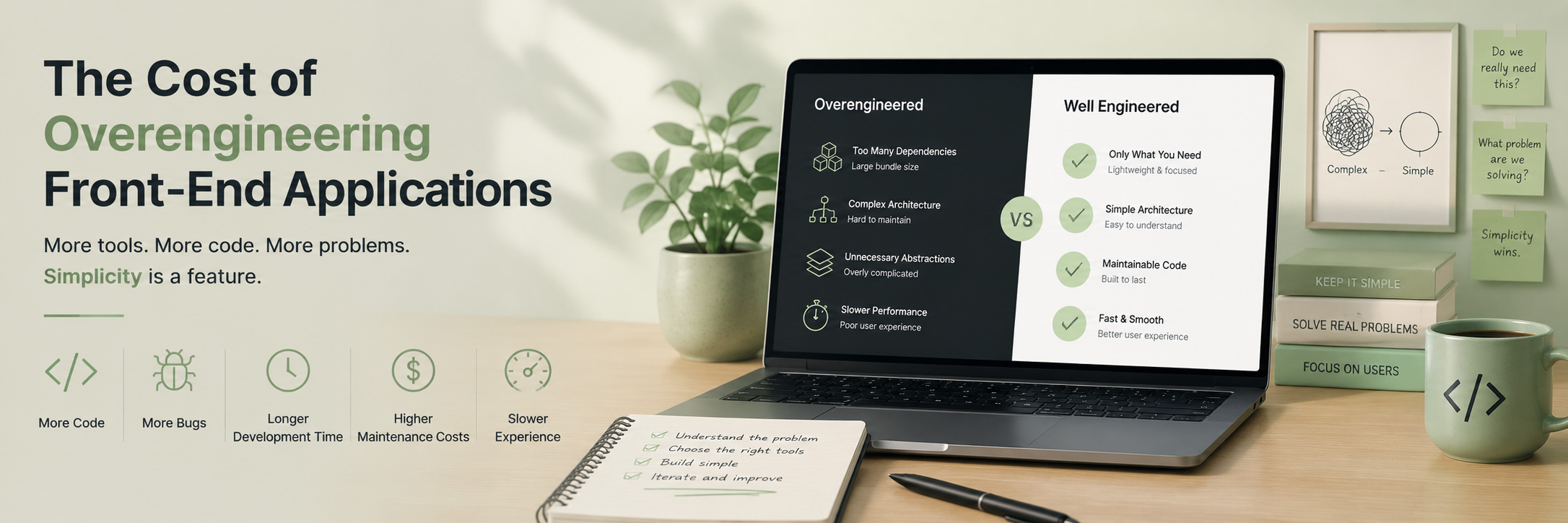
Modern front-end development has never been more powerful. We have access to amazing frameworks, libraries, build tools, and design systems that help us create fast and interactive web applications.
However, having more tools does not always lead to better solutions.
One of the most common mistakes developers make is overengineering: adding complexity to a project before it is actually needed.
Early in my front-end journey, I often believed that adding more tools would automatically improve a project. Over time, I learned that every dependency and architectural decision comes with a cost.
↠ In many cases, the simplest solution is often the best one.
What Is Overengineering?
Overengineering happens when we build a solution that is much more complex than the problem requires.
Some examples:
↠ A simple landing page suddenly includes multiple state management libraries.
↠ A small website is built with a large architecture designed for enterprise applications.
↠ A feature that could be implemented with a few lines of CSS ends up requiring additional JavaScript, dependencies, and maintenance.
The result is usually the same:
- More code
- More bugs
- Longer development time
- Higher maintenance costs
Complexity is not always a sign of quality.
Why Does It Happen?
There are several reasons why developers overengineer applications.
Following Trends
The front-end ecosystem evolves very quickly.
Every year new frameworks, libraries, and development patterns become popular.
It is tempting to use the latest tool simply because everyone is talking about it, but popularity does not automatically make a tool the right choice for every project.
Planning for Problems That Do Not Exist Yet
Earlier in my learning journey, I often spent more time designing the “perfect architecture” than actually building features. In most cases, the projects were never large enough to justify that complexity.
Building for hypothetical future requirements often creates unnecessary technical debt in the present.
Wanting to Showcase Technical Skills
We, developers, naturally want to demonstrate our abilities.
Sometimes we choose the most sophisticated solution because it looks impressive.
But good engineering is not about showing how much technology you can use.
It is about solving problems efficiently.
Common Examples in Front-End Development
Using a Framework for a Simple Website
Frameworks such as React are excellent tools.
However, not every website needs a full client-side application architecture.
For a small business website, portfolio, or marketing page, a simpler solution may be easier to maintain and faster to load.
Adding State Management Too Early
Global state management can be extremely useful in large applications.
But introducing additional complexity before it becomes necessary can make development harder rather than easier.
Many projects work perfectly well with local component state and simple data flow.
Installing Dependencies for Everything
Modern development often encourages dependency-heavy solutions.
↠ Need a date formatter? Install a package.
↠ Need a simple animation? Install another package.
↠ Need a small utility function? Add one more dependency.
Over time, these decisions increase bundle size, security risks, and maintenance requirements.
And sometimes the browser already provides everything we need.
The Hidden Cost of Complexity
The biggest problem with overengineering is that its cost is often invisible at first.
The application may work perfectly during development.
But the real cost appears later:
- New developers need more time to understand the codebase.
- Features take longer to implement.
- Bugs become harder to track.
- Refactoring becomes more expensive.
Every architectural decision introduces a maintenance cost.
The question is whether the benefit justifies that cost.
Simplicity Is a Competitive Advantage
Working on both custom projects and CMS-based websites has taught me that different projects require different levels of complexity.
Not every website needs an advanced front-end architecture to deliver value.
Furthermore, simple applications are easier to understand, test, and improve.
They are often faster to develop and cheaper to maintain.
This does not mean avoiding modern tools.
It means using them when they solve a real problem.
Good developers do not choose the most complex solution.
They choose the most appropriate one.
Final Thoughts
Modern front-end development gives us incredible possibilities.
But every new tool, library, or architectural pattern should have a clear purpose.
Before adding complexity to a project, it is worth asking a simple question:
“What problem am I solving?”
↠ If the answer is unclear, I believe that the simplest solution is probably the better one.
After all, users do not care how sophisticated the architecture is.
They care that the website or application works.