
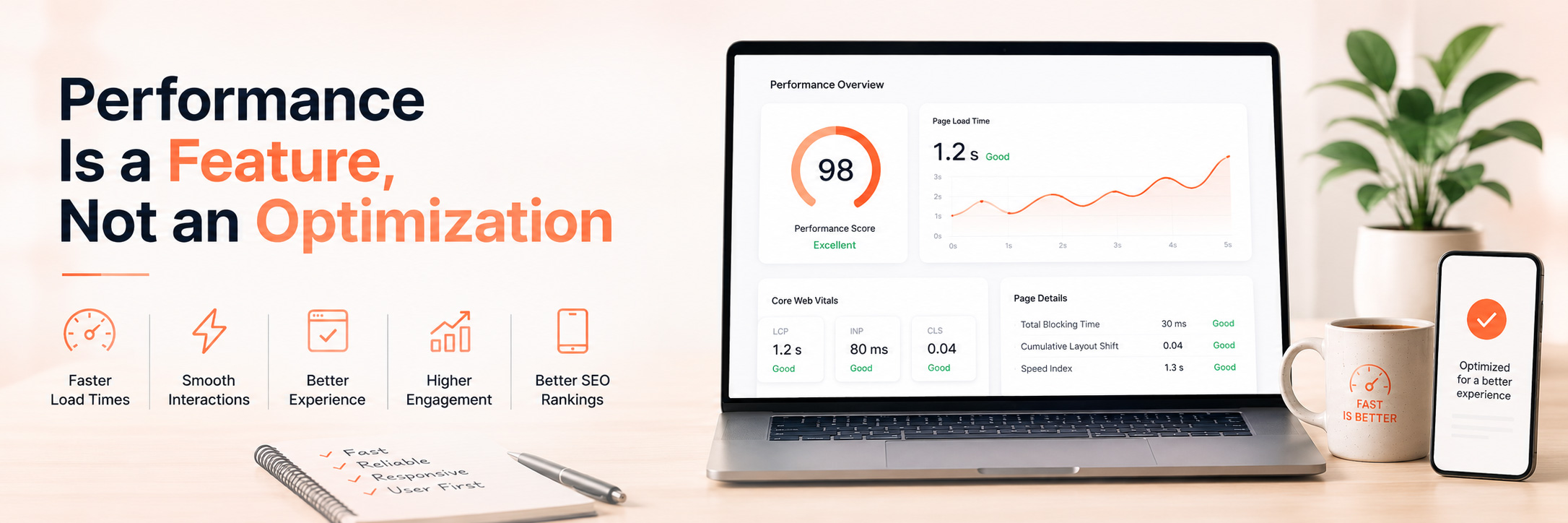
When people talk about web performance, they often treat it as something optional. A final step, a small improvement, or an optimization that can be done later.
But performance is not an extra improvement. It is part of the product itself.
Users Notice Performance Immediately
Users do not measure performance in numbers or metrics. They feel it.
A slow website creates frustration before the page even finishes loading. A fast website feels smooth, responsive, and reliable.
In most cases, users will not wait. They will simply leave.
Performance Is Part of UX
Performance is not only a technical concern. It is a user experience decision.
For the user, there is no separation between design, functionality, and performance. Everything is part of the same experience.
Good UX depends on good performance.
- How fast a page loads
- How quickly interactions respond
- How smooth transitions feel
- How stable the layout is while loading
A well-designed interface loses its value if it is slow or unresponsive.
Why Performance Is Often Ignored
In many projects, performance is treated as something to “fix later”.
This usually happens because of:
- Focus on features first, optimization later
- Assumption that modern devices can handle everything
- Lack of awareness about real user conditions
- Overuse of heavy frameworks and dependencies
This approach often leads to applications that are harder to improve later.
The Cost of Poor Performance
Performance issues are not always obvious during development, but in production they become real problems:
- Higher bounce rates
- Lower user engagement
- Worse SEO rankings
- Poor mobile experience
- Loss of user trust
A slow product feels less professional, even if the design is good.
Thinking About Performance From the Start
↠ Good performance is not something you add at the end. It is something you consider from the beginning of a project.
Small decisions make a big difference:
- Using images correctly
- Avoiding unnecessary JavaScript
- Reducing heavy dependencies
- Keeping components lightweight
- Designing with loading states in mind
These choices accumulate over time and define the final experience.
The Role of the Developer
As front-end developers, we directly influence performance.
We decide:
- how the UI is rendered
- how data is loaded
- how heavy the application becomes
- how users experience interactions
This means performance is not only a system concern. It is a developer responsibility.
My Perspective
In my experience working with front-end technologies and CMS-based platforms, I have seen that the fastest solutions are often also the simplest ones.
When a project is lightweight and well-structured, it is easier to maintain, scale, and improve over time.
Performance is not something you add at the end. It is something you build into the foundation.
Final Thoughts
Performance is not an optimization step. It is a core feature of every web application.
No matter how good a product looks or how many features it has, users will always prefer something that feels fast and responsive.
Because in the end, speed is a crucial part of the experience.